To calculate your next period, you only need two numbers: the first day of your last period and your average cycle length. Knowing that date is not just convenient for packing supplies or planning a trip. It is also one of the simplest ways to understand how your menstrual cycle behaves from month to month.
Whether you want to manage PMS better, check whether a late bleed is unusual for you, or compare your own estimate with a calculator result, the underlying method is the same. You start with your last period, measure your cycle length, and project forward.
The good news is that the math is simple enough to do in under a minute. This guide shows you how to calculate your next period date manually, what to do if your cycles are irregular, why predictions sometimes miss, and how to use the full period calculator when you want the fast version. → Skip to the calculator
The Simple Formula to Predict Your Next Period
The basic formula behind period prediction is straightforward: take the first day of your last period and add your average cycle length. That is the same logic used by most period apps, paper cycle charts, and quick online tools. It works best when your cycles are fairly regular, but it also gives you a starting point when you are still learning your pattern.
What matters most is using the correct dates. You are not adding the number of bleeding days. You are not counting from the last day of spotting. You are adding your cycle length to day 1 of your most recent period. Once that clicks, period calculation becomes much easier.
The Period Calculation Formula
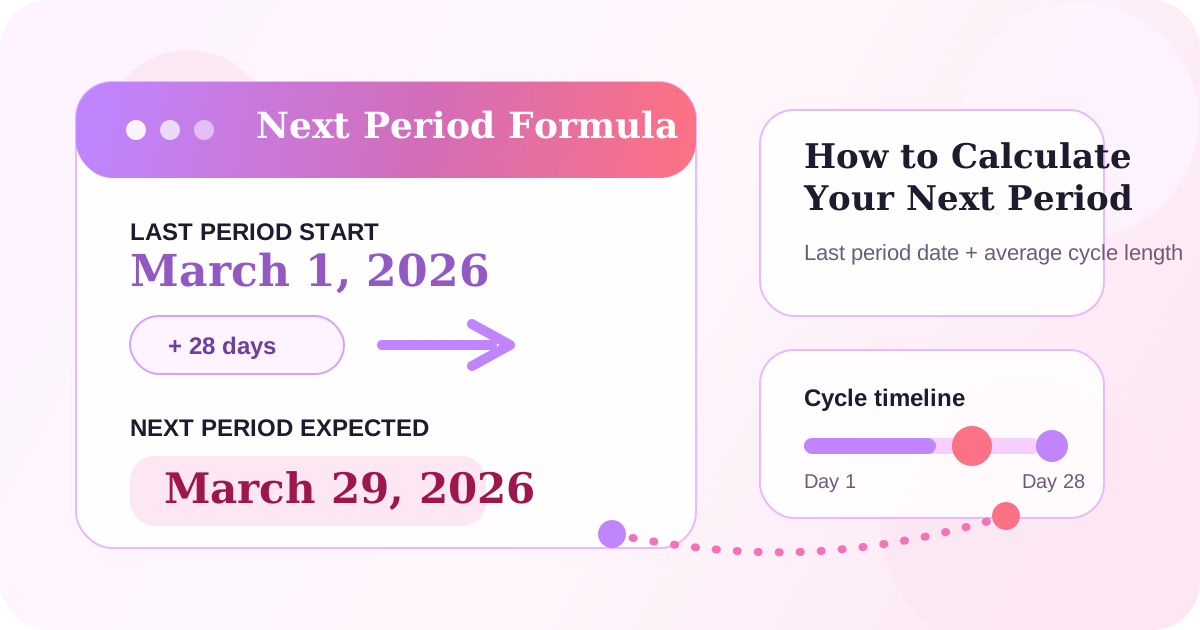
Next Period Date = Last Period Start Date + Average Cycle Length (days)
Example
Last period started
March 1, 2026
Average cycle length
+ 28 days
Next period expected
= March 29, 2026
Step 1 – Find the First Day of Your Last Period
The only date that counts here is the first day of full menstrual bleeding. That day is day 1 of your cycle. If you use the last day of bleeding instead, your period calculation will be off before you even start.
If you do not remember the date exactly, check your phone calendar, notes app, messages, or a cycle app. If you are not tracking yet, start now with our period tracker. A simple record of start dates is enough to make future calculations much easier.
Step 2 – Know Your Average Cycle Length
Your cycle length is the number of days from the first day of one period to the first day of the next. For many adults, a normal cycle length falls between 21 and 35 days, with 28 days often used as the default example. If you do not know your number yet, 28 days is a reasonable starting estimate, but it is still only an estimate.
The more accurate approach is to track at least 3 to 6 cycles and calculate the average. That helps smooth out one unusual month. If you want to see the full method, jump to how to calculate your average cycle length.
Step 3 – Add Your Cycle Length to Get the Next Date
Once you have your last period start date and your average cycle length, add them together. That gives you the most likely start date for your next period. You can count days manually on a calendar, use the date picker on your phone, or skip the counting and use the calculator lower on this page.
Always add from the start date, not from the day your bleeding ended. That small distinction is the reason many self-calculated predictions end up several days off.
Worked Examples by Cycle Length
Not everyone has a 28-day cycle, and that is completely normal. The formula stays the same, but the final date changes when your cycle length changes. These examples show exactly how to predict next period timing for four common cycle lengths.
28-Day Cycle Example
A 28-day cycle is the classic example because it is easy to explain, not because it is the only normal one. If your last period started on March 1, 2026, and your average cycle length is 28 days, your next period is expected around March 29, 2026.
Example: 28-Day Cycle
Last period started
March 1, 2026 (Sunday)
Average cycle length
28 days
Calculation
March 1 + 28 days = March 29, 2026
Next period expected
March 29, 2026 (Sunday)
Ovulation estimated
March 15, 2026 (Day 14)
Fertile window
March 10 - 16, 2026
If you want a fertility-first view of the same calculation, open the ovulation calculator. It uses the same cycle logic, but it puts ovulation timing and the fertile window at the center of the display.
30-Day Cycle Example
A 30-day cycle pushes the next period slightly later. Instead of landing on March 29, the same March 1 start date moves your next expected period to March 31. Ovulation also tends to move later in the cycle, often around day 16 instead of day 14.
Example: 30-Day Cycle
Last period started
March 1, 2026
Average cycle length
30 days
Calculation
March 1 + 30 days = March 31, 2026
Next period expected
March 31, 2026
Ovulation estimated
March 17, 2026 (Day 16)
Fertile window
March 12 - 18, 2026
21-Day Cycle Example
A shorter cycle means your next period arrives much sooner. If you calculate your next period from March 1 using a 21-day cycle length, the predicted start date becomes March 22. With short cycles, fertile days also arrive much earlier than many people expect.
Example: 21-Day Cycle
Last period started
March 1, 2026
Average cycle length
21 days
Calculation
March 1 + 21 days = March 22, 2026
Next period expected
March 22, 2026
Note
With a 21-day cycle, fertile days can begin very early in the cycle.
35-Day Cycle Example
Longer cycles are still normal for many people. If your cycle length is 35 days, a March 1 start date points to an expected next period around April 5. What changes most in this pattern is the follicular phase, which is why ovulation lands later than the standard 14-day example.
Example: 35-Day Cycle
Last period started
March 1, 2026
Average cycle length
35 days
Calculation
March 1 + 35 days = April 5, 2026
Next period expected
April 5, 2026
Note
Longer cycles usually mean ovulation happens later, around day 21 rather than day 14.
Use Our Free Period Calculator (Skip the Math)
If you would rather skip the manual math, our free period calculator handles the date counting instantly. Enter your last period date and average cycle length below and the next period date, estimated ovulation day, and fertile window update in real time.
This is especially useful when you want a quick answer to questions like “when will my next period come” or “how many days until my next period” without counting ahead on a paper calendar.
Period Calculator
Loading the live calculator…
How to Calculate Your Average Cycle Length
If you want period predictions to get better over time, averaging several cycles matters more than memorizing a single “usual” month. One cycle can be affected by stress, travel, illness, or poor sleep. Three to six cycles give you a much stronger baseline because they show the pattern instead of a one-off exception.
This is also the easiest way to calculate period cycle length accurately if you have ever felt uncertain about whether your cycle is 27 days, 29 days, or somewhere in between. Instead of guessing, you let the dates tell you the average.
How to Calculate Your Average Cycle Length
Step 1: Write down the first day of your last 3 to 6 periods
Example: Jan 3, Feb 1, Mar 1, Mar 29
Step 2: Calculate each cycle length
Jan 3 to Feb 1 = 29 days
Feb 1 to Mar 1 = 28 days
Mar 1 to Mar 29 = 28 days
Step 3: Add them up and divide by the number of cycles
(29 + 28 + 28) ÷ 3 = 28.3 days
Round to the nearest whole number = 28 days
Your average cycle length: 28 days
If you only have one recent cycle recorded, use 28 days as a starting estimate and keep tracking. With three cycles, you can usually get a reliable average. With six cycles, you start to see whether your timing is genuinely regular. With twelve cycles, it becomes much easier to notice recurring shifts around school, travel, seasonal stress, or lifestyle changes.
If you would rather not do this by hand each month, our period tracker can help you log start dates and build the average automatically.
How to Calculate Your Next Period With Irregular Cycles
If your cycles do not follow a consistent pattern, the simple next-period formula becomes less precise. That does not mean period prediction becomes useless. It means you should stop expecting one exact date and start thinking in terms of estimates and ranges.
For irregular cycles, two methods work better than guessing from your last month alone: the average method and the range method. Both are more honest about uncertainty, and both let you calculate your next period in a way that matches real-life variation.
The Average Method
Start by collecting the lengths of your last six cycles. Add them together and divide by six to get the average. Then use that average in the normal formula: first day of your last period plus average cycle length. This gives you a practical middle estimate when your timing shifts, but not wildly.
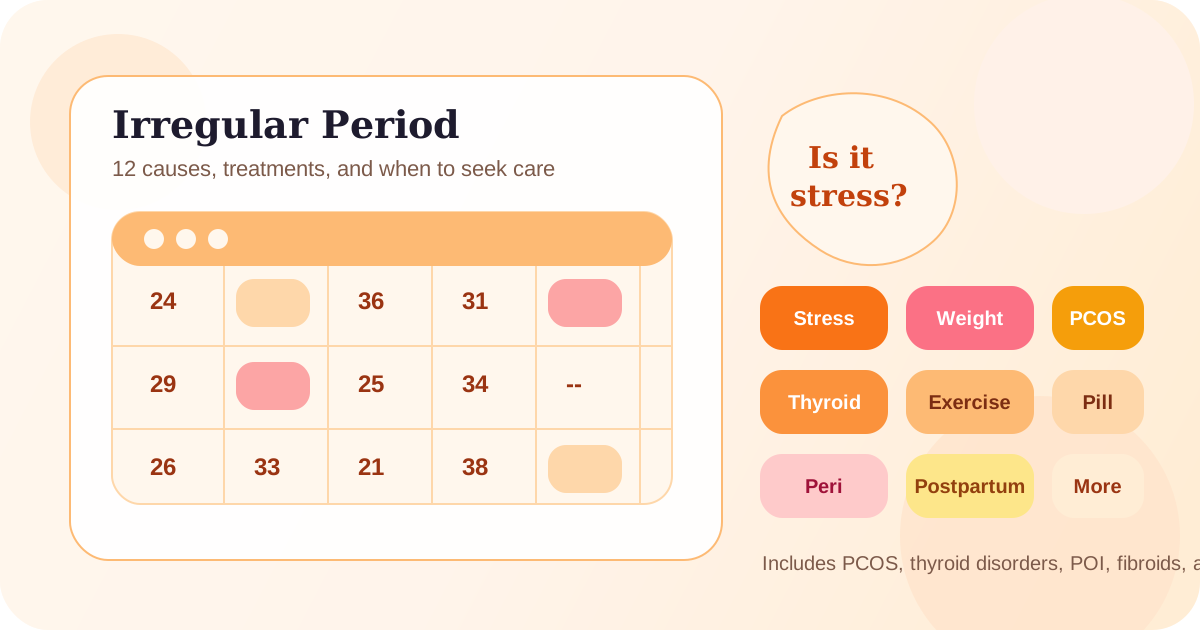
Example: 24, 31, 27, 35, 26, and 29 days. The average is 28.7 days, which rounds to 29. If your last period started on March 1, your next period estimate is March 30. The limitation is that an average can hide the fact that your cycles actually swing over a much wider range.
The Range Method
If your timing varies a lot, the range method is usually more useful than one single date. Instead of asking “When will my next period come exactly?”, you ask “What window is most likely?” Take the shortest recent cycle and the longest recent cycle, then add both numbers to the first day of your last period.
This gives you an earliest expected date and a latest expected date. It is a better mental model for people whose cycles are irregular because it matches the way real variation shows up on the calendar.
Range Method Example
Recent cycles
24, 31, 27, 35, 26, 29 days
Shortest cycle
24 days
Longest cycle
35 days
Last period started
March 1
Earliest possible
March 1 + 24 = March 25
Latest possible
March 1 + 35 = April 5
Expected window
March 25 - April 5
If you want a fertility-focused companion tool while your cycle is inconsistent, the safe period calculator can help you think in windows rather than fixed dates. Just remember that fertility predictions also become less precise when cycle timing is irregular.
When to Stop Relying on Calculations
If your cycle variation is more than about 14 days from one month to the next, calendar calculations lose a lot of practical value. At that point, you may get more useful information from ovulation predictor kits, basal body temperature tracking, or clinician-guided evaluation for causes such as PCOS, thyroid problems, or major hormonal disruption.
Period calculators are planning tools, not diagnostic tools. They are most helpful when they help you notice a pattern and decide whether it is time to look deeper.
What Affects Your Period Calculation
Even when you know how to calculate your next period correctly, the prediction is still based on an assumption: that your body will follow roughly the same hormonal timeline it followed before. Real life gets in the way of that assumption all the time.
6 Factors That Can Shift Your Period Date
Stress
High stress can raise cortisol and delay ovulation, which usually pushes the next period later. Positive stress counts too, including moving, travel, exams, and major life changes.
Travel and time zone changes
Crossing time zones can disrupt sleep, appetite, and daily rhythm. Those changes can affect the hormone signals that help regulate ovulation.
Significant weight change
Rapid loss or gain can influence estrogen levels. Very low energy availability can stop ovulation altogether for some people.
Intense exercise
Heavy endurance training or sudden spikes in training volume can delay or suppress ovulation, especially when nutrition and recovery do not keep up.
Illness
A fever, infection, or significant illness in the first half of the cycle can shift ovulation by several days and move the next period with it.
Medications
Emergency contraception, steroids, some antipsychotics, and some antidepressants can all influence cycle timing. If a timing change appears after a new medication, make a note of it.
This is why period calculations should always be treated as estimates, not guarantees. The formula gives you the most likely date based on your pattern so far, but your body responds to what is happening in your life. Tracking those events in your notes can make later cycle shifts much easier to explain.
How Accurate Are Period Predictions?
For very regular cycles, period predictions are often useful within a day or two. For mildly variable cycles, they are still useful for planning, but the window widens. For irregular cycles, the calculator can still help you prepare, but it is much weaker as a “single exact date” tool.
No one can predict a period with 100 percent certainty because the method is based on past timing patterns, not a direct measurement of this month’s ovulation. That is also why most clinicians suggest treating the predicted date plus or minus a few days as the realistic window.
Prediction Accuracy by Cycle Regularity
Very regular cycles
Variation usually stays within 0 to 2 days
~95%
Regular cycles
Variation usually stays within 3 to 4 days
~80%
Slightly irregular cycles
Variation usually stays within 5 to 7 days
~65%
Irregular cycles
Variation regularly exceeds 8 days
~45%
The simplest way to improve prediction accuracy is to keep tracking. Six or more cycles usually give you a better average, a better sense of your personal variation, and a better sense of when a “late” period is actually late for you.
Signs Your Period Is Coming Soon
Calculating your next period is one side of the prediction. The other side is learning the physical signals that your body tends to send before bleeding starts. Those signs do not replace the calendar method, but they help you confirm whether your usual pattern is showing up on time.
Period Warning Signs Timeline
1 to 2 weeks before
Bloating, breast tenderness, cravings, fatigue, irritability, anxiety, and water retention often start after ovulation during the luteal phase.
2 to 3 days before
Mild cramps, low back ache, headaches, breakouts, and light spotting may appear as your next period gets closer.
1 day before or day of
Stronger cramps, heavier spotting, digestive changes, and a heavier feeling in the lower abdomen often show that bleeding is about to start or has already begun.
Everyone’s PMS profile is slightly different. Logging symptoms beside your dates makes it much easier to recognize your personal pattern. Use the notes field in our period tracker to keep a record of what your body tends to do before each cycle starts.
When to See a Doctor About Your Period
Period calculations are helpful for planning, but there are clear situations where a calendar should not be your only guide. If your cycle changes sharply or symptoms become disruptive, the right next step is medical evaluation rather than more math.
See a Doctor If You Experience
Periods consistently shorter than 21 days or longer than 35 days
Periods that last more than 7 days
Extremely heavy bleeding, such as soaking a pad or tampon every hour for 2 or more consecutive hours
Severe pain that interferes with normal daily activities
No period for 3 or more consecutive months when you are not pregnant
A sudden major change in your usual pattern that lasts for 2 to 3 cycles
A period more than 2 weeks late with a negative pregnancy test
This article is for educational purposes only and does not constitute medical advice. If you have concerns about your menstrual health, please consult a qualified healthcare provider. Period tracking tools are planning aids, not diagnostic instruments.
Frequently Asked Questions
These answers cover the most common verification questions people ask after they calculate their next period manually or compare that result with a period tracker or calculator.