A normal menstrual cycle is much broader and more flexible than most people were taught. If you have ever looked at a calendar and wondered whether your cycle is too short, too long, too heavy, or just different from the textbook example, you are asking one of the most common menstrual health questions there is.
For years, the 28-day cycle was repeated as if it were the gold standard. In reality, large studies show that the real average is closer to 29 days, and many healthy cycles sit somewhere between the mid-20s and low-30s. That is why comparing yourself to one fixed number is often less useful than comparing yourself to your own usual pattern.
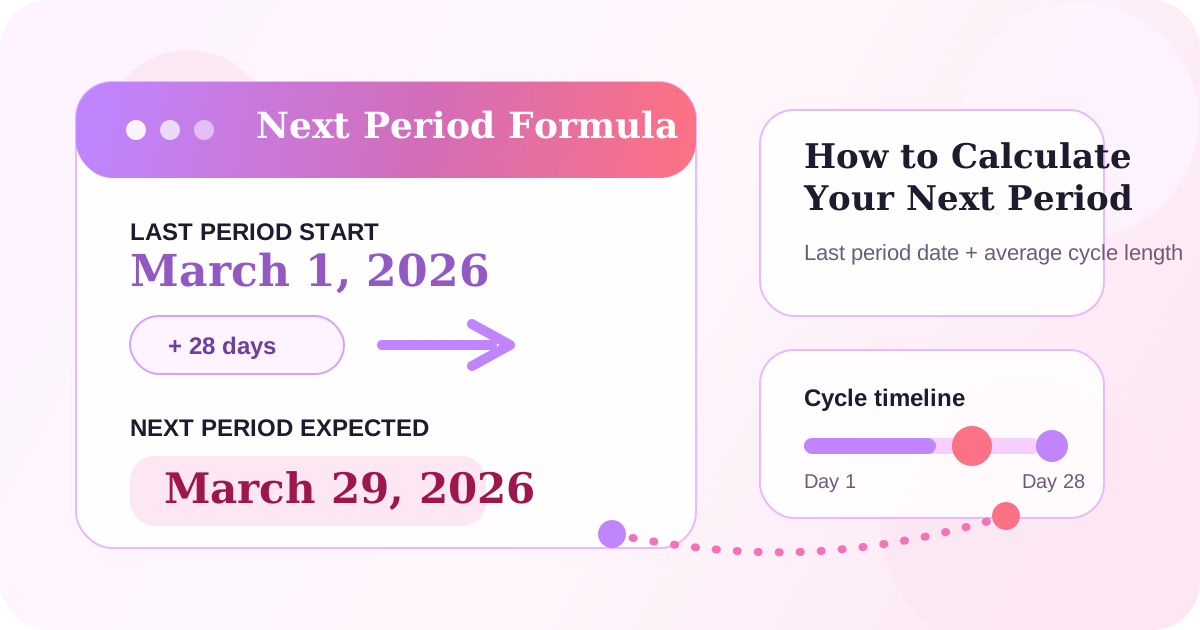
This guide breaks down what counts as a healthy cycle, including normal period cycle length, the four phases of the menstrual cycle, normal flow, normal period duration, and the signs that something may be off. If you want a practical follow-up after reading, compare your dates with the period calculator or review the hands-on guide to how to calculate your next period. → Jump to the Normal vs. Abnormal comparison
The Quick Answer: What "Normal" Really Means
In practical terms, a normal menstrual cycle is a recurring pattern of hormonal changes that leads to regular uterine lining growth, ovulation in many cycles, and menstrual bleeding when pregnancy does not occur. The exact timing varies from person to person, which is why medical guidelines define a normal range rather than a single exact number.
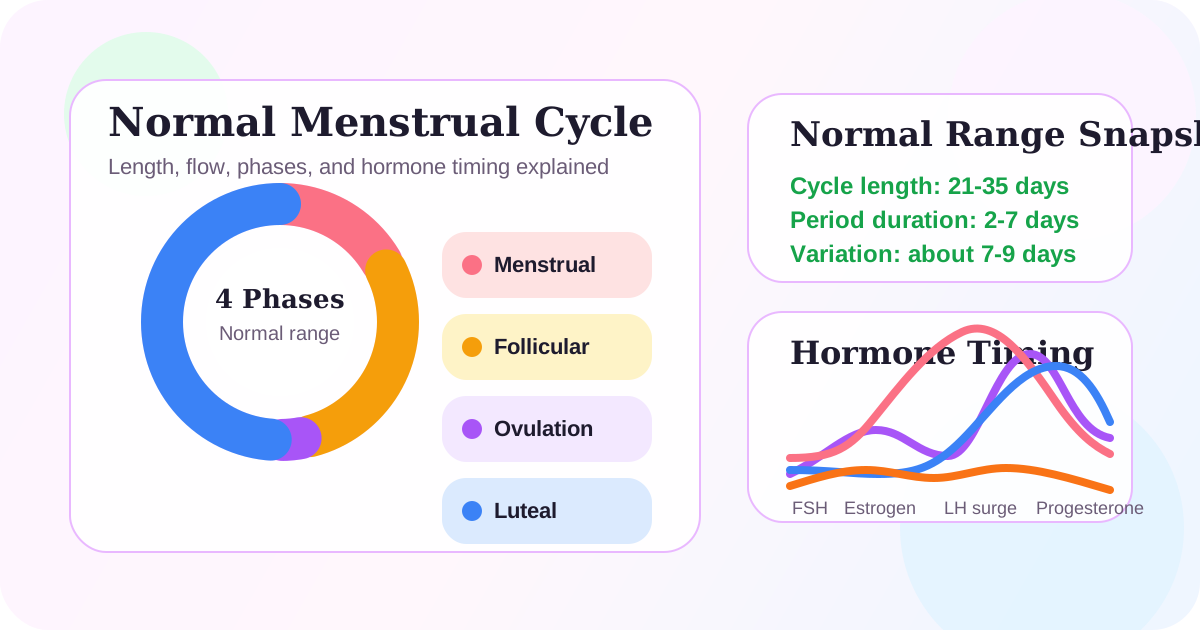
According to ACOG guidelines and broader reproductive health references from the WHO, normal cycle length for adults usually falls between 21 and 35 days, period duration usually falls between 2 and 7 days, and some month-to-month variation is expected. A one-off shift means far less than a repeated change.
What Is a Normal Menstrual Cycle?
Cycle length
21 - 35 days
Period duration
2 - 7 days
Blood loss
5 - 80 ml total
Cycle variation
Up to 7 - 9 days month to month
Color
Pink, red, dark red, or brown
Most important marker
A cycle that is reasonably consistent and predictable for you personally
This is the key mindset shift: “normal” does not mean you must match a textbook 28-day diagram. It means your cycle behaves within a healthy range and does so with a pattern that makes sense for your body, age, and life stage.
Normal Cycle Length – What the Research Says
The 28-day cycle has been taught for decades because it is easy to remember and easy to diagram. But large population studies show that it is better understood as a convenient example than a universal standard.
Classic work by Treloar and colleagues, later population studies by Chiazze, and modern app-based data from NPJ Digital Medicine all point to the same conclusion: normal menstrual cycle length spans a real range, and relatively few cycles land on exactly day 28 month after month.
What Research Says About Cycle Length
Treloar et al. (1967) – 275,947 cycles analyzed
True average cycle length: 29.1 days
Most common range: 24 - 32 days
Chiazze et al. (1968) – 30,655 cycles
Cycles of exactly 28 days: about 12.4%
Cycles between 25 - 31 days: about 70%
Modern app-based data (2019)
Median cycle length: 29 days
Cycles 21 - 35 days: roughly 95% of adult cycles
That is why stability matters more than chasing one “perfect” number. A stable 26-day cycle is not worse than a stable 31-day cycle. The question to ask is whether your timing stays within a predictable band or whether it is drifting sharply without a clear explanation.
Is a 21-Day Cycle Normal?
Yes. A 21-day cycle sits at the short end of the normal adult range, but it is still within the accepted window. If your cycle has always been around 21 days and stays there consistently, it can be normal for you. If it suddenly becomes shorter than usual, especially if that comes with heavier bleeding or pain, that change matters more than the number alone.
Is a 28-Day Cycle the Standard?
It is the most familiar example, not the only healthy one. Only a minority of cycles are exactly 28 days, and many educational diagrams quietly assume ovulation happens on day 14 because they are built around that number. You should not assume something is wrong simply because your cycle is not 28 days long.
Is a 35-Day Cycle Normal?
Yes, if it is stable. A 35-day cycle sits at the longer end of the normal range and often means ovulation happens later in the cycle. If your pattern stretches beyond 35 days repeatedly or becomes less predictable than usual, that is the point where a longer cycle starts to move from “normal variation” toward “worth evaluating.”
The 4 Phases of the Menstrual Cycle
The menstrual cycle is not just the days you bleed. It is a coordinated hormonal sequence that unfolds across four commonly described phases. Understanding these phases helps explain why your energy, discharge, symptoms, and mood can shift over the course of the month.
The 4 Phases of Your Menstrual Cycle
Loading the cycle phase diagram…
Phase 1 – Menstrual Phase (Days 1–5)
Phase 1: Menstrual Phase
Timing
Days 1 - 5 on average
What is happening
The uterine lining sheds as estrogen and progesterone fall.
Hormones
Estrogen down, progesterone down, FSH begins rising
You may feel
Bleeding, cramps, fatigue, bloating, lower back discomfort
Normal duration
2 - 7 days
The menstrual phase begins when the uterine lining built during the prior cycle is no longer supported and starts to shed. That shedding is what creates menstrual bleeding. Prostaglandins help the uterus contract so the lining can exit, and those same compounds help explain why cramps happen.
Blood color often changes within this phase. Bright red blood is common when flow is fresh and moving quickly. Dark red or brown blood is common when the flow slows and blood spends longer leaving the body. The menstrual phase overlaps with the start of the follicular phase, which is why day 1 belongs to both descriptions.
Phase 2 – Follicular Phase (Days 1–13)
Phase 2: Follicular Phase
Timing
Days 1 - 13 in a 28-day example
What is happening
FSH recruits follicles and one dominant follicle eventually emerges.
Hormones
FSH rises, estrogen rises, LH starts to build
You may feel
More energy, clearer thinking, better mood, thinner cervical mucus
Key event
Dominant follicle usually stands out around day 7
In the follicular phase, the pituitary gland releases FSH, which encourages several ovarian follicles to start growing. Most do not make it all the way to ovulation. One typically becomes dominant and produces increasing amounts of estrogen.
Estrogen rebuilds the uterine lining after menstruation. It also helps explain why many people feel physically and mentally better in this part of the cycle. Cervical mucus often becomes more slippery and more fertile as ovulation approaches.
Phase 3 – Ovulation Phase (Day 14)
Phase 3: Ovulation Phase
Timing
Around day 14 in a 28-day cycle, but earlier or later in other cycles
What is happening
An LH surge triggers the dominant follicle to release an egg.
Hormones
LH surges sharply, estrogen peaks and then dips
You may feel
Egg-white cervical mucus, increased libido, mild one-sided pelvic pain
Fertility
This is the only phase when pregnancy can begin
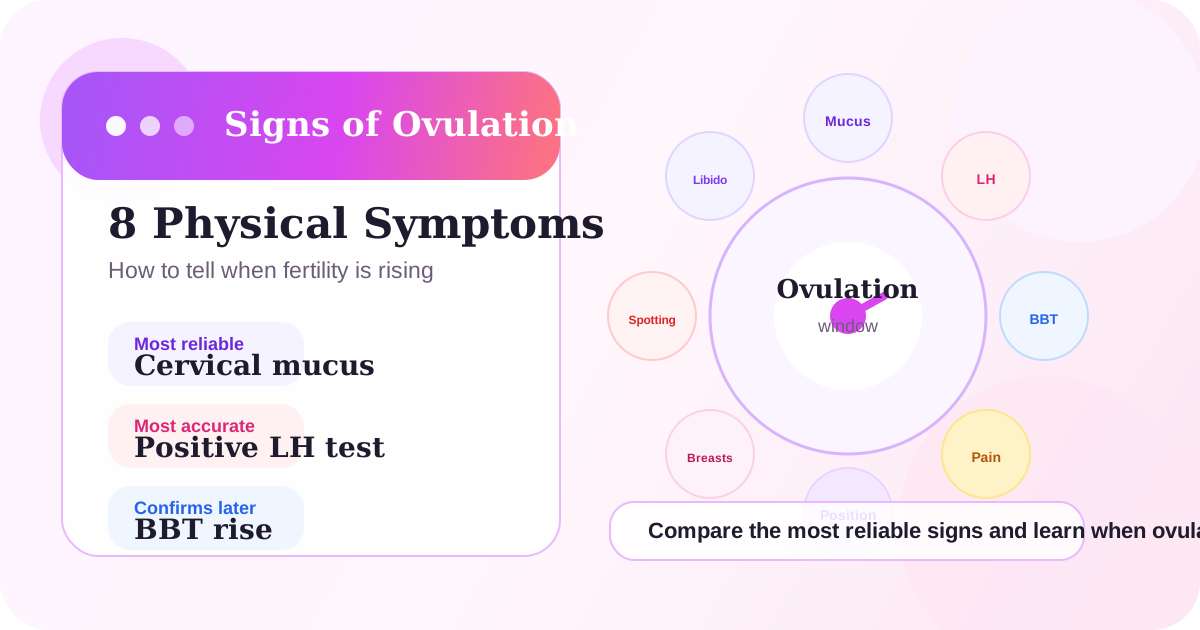
Ovulation is short. The egg remains viable for roughly 12 to 24 hours after release, while sperm may survive for several days in fertile cervical mucus. That is why the fertile window is wider than the ovulation day itself.
Ovulation does not always happen on day 14. It depends on overall cycle length and on when the follicular phase wraps up. If you want an estimate for your own pattern, use the ovulation calculator. If you are trying to understand lower-fertility days as well, the safe period calculator gives a wider cycle view.
Phase 4 – Luteal Phase (Days 15–28)
Phase 4: Luteal Phase
Timing
Days 15 - 28 in a 28-day example
What is happening
The corpus luteum produces progesterone to support the uterine lining.
Hormones
Progesterone rises, estrogen has a smaller second rise, then both fall
You may feel
Bloating, breast tenderness, cravings, fatigue, mood shifts
Typical duration
Usually 12 - 16 days and often the most stable phase
After ovulation, the emptied follicle becomes the corpus luteum. Its main job is to produce progesterone, which helps the uterine lining stay thick and ready in case implantation happens.
If pregnancy does not occur, the corpus luteum breaks down, progesterone falls, and the lining becomes less stable, which leads back to the next period. If pregnancy does occur, hCG supports the corpus luteum so progesterone stays elevated. This phase is often the most stable in length, which is why calculators usually work backward from the next expected period to estimate ovulation timing.
What Is Normal Period Flow?
Flow intensity is one of the most personal parts of menstruation, and it is also one of the easiest parts to misjudge because people tend to compare themselves with friends, internet anecdotes, or the most dramatic months they remember. Normal flow covers a surprisingly broad range.
Flow Intensity: Light, Medium, and Heavy
Period Flow Reference Guide
| Pattern | Approximate amount | What it often feels like |
|---|---|---|
| Spotting | < 5 ml/day | Barely visible, often no full pad needed |
| Light | 5 - 15 ml/day | 1 - 2 pads or tampons per day |
| Medium | 15 - 25 ml/day | 3 - 4 products per day |
| Heavy | 25 - 40 ml/day | Changing roughly every 2 - 3 hours |
| Very heavy | > 40 ml/day | Changing every 1 - 2 hours and watching for leaks |
Total normal blood loss per period: 5 - 80 ml. The average sits closer to 30 - 40 ml, or about 2 to 3 tablespoons. Soaking a pad or tampon every hour for 2 or more consecutive hours counts as heavy menstrual bleeding and deserves evaluation.
In many normal periods, the first 1 to 2 days are the heaviest, the middle days are moderate, and the final days are lighter or more brown. Flow can also change with age, after pregnancy, and during perimenopause. What matters most is whether your flow stays in a pattern that makes sense for you or suddenly becomes much heavier, much longer, or much more disruptive.
Normal Period Blood Color Guide
Period Blood Color Guide
Bright red
Fresh blood, common on heavier days when flow is moving quickly.
Dark red
Slightly older blood, still normal throughout the period.
Brown or very dark
Older blood, especially common at the beginning or end of a period.
Pink or light pink
More diluted blood, often seen with spotting or very light flow.
Orange-ish
Sometimes a mix of blood and cervical fluid. Watch the context and other symptoms.
Gray or green
Not considered normal and may suggest infection.
Color by itself is only one clue. A little brown blood at the start or end of a period is extremely common. What matters more is the whole picture: odor, pain, fever, unusual discharge, and whether the bleeding is happening at the time you would expect a period.
Normal vs. Abnormal Clots
Small clots can be completely normal, especially on heavier days when blood exits faster than the body’s natural anticoagulants can fully break it down. Clots larger than a coin, clots that happen repeatedly, or clots that show up together with very heavy bleeding deserve more attention because they can point to fibroids, adenomyosis, or other bleeding problems.
Normal Period Duration
Period Duration Reference
Too short
Less than 2 days
Normal
2 - 7 days, with many people around 4 - 5 days
Too long
More than 7 days
Typical pattern
Days 1 - 2 heaviest, days 3 - 4 moderate, days 5 - 7 lighter
Period duration can naturally shift by a day or two from month to month. That is still compatible with a normal pattern. A meaningful change is when your periods become consistently much shorter, much longer, or are suddenly accompanied by heavier flow, spotting between periods, or worsening pain.
If you want a clearer answer about what your own bleeding pattern has been doing over time, use the period tracker to log your duration, start dates, and flow notes instead of relying on memory.
Hormones That Control Your Cycle
The menstrual cycle is governed by the hypothalamic-pituitary-ovarian axis, often shortened to the HPO axis. The hypothalamus starts the conversation by releasing GnRH. The pituitary responds by releasing FSH and LH. The ovaries then respond by producing estrogen and progesterone.
Key Hormones in Your Menstrual Cycle
| Hormone | Produced by | Primary role |
|---|---|---|
| FSH | Pituitary gland | Stimulates follicle growth |
| LH | Pituitary gland | Triggers ovulation |
| Estrogen | Ovaries | Builds the uterine lining and supports the follicular phase |
| Progesterone | Corpus luteum | Maintains the lining after ovulation |
| GnRH | Hypothalamus | Controls FSH and LH release upstream |
Hormone Levels Through Your Cycle
Loading the hormone chart…
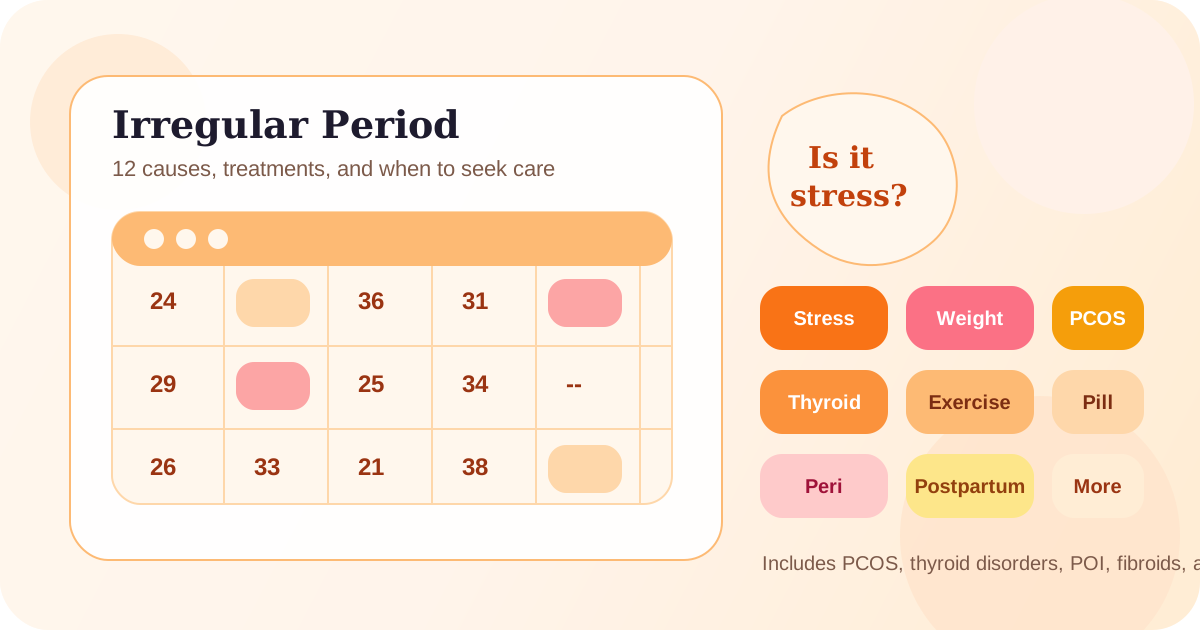
Hormone imbalance is a simplified phrase, but it captures something real: if the signals between the brain and ovaries are disrupted, cycle timing changes. That disruption can come from chronic stress, low energy availability, illness, thyroid disease, PCOS, or some medications. The result is often delayed ovulation, skipped ovulation, or unpredictable bleeding.
What Affects Your Cycle Length?
Cycle length is not set in stone. It changes when ovulation changes, and ovulation is sensitive to multiple internal and external factors. Some influences stretch cycles longer, some shorten them, and some create temporary one-off disturbances that disappear once life settles down.
Factors That Can Change Your Cycle Length
Make cycles longer
- Chronic stress
- PCOS
- Thyroid disorders
- Significant weight gain
- Stopping hormonal birth control
- Breastfeeding
- Perimenopause transitions
Make cycles shorter
- Acute stress in some people
- Intense exercise or low energy availability
- Significant weight loss
- Perimenopause onset for some cycles
- Hormonal contraception changes
- Uterine polyps or bleeding disorders in some cases
The practical distinction is whether a change is temporary or persistent. A delayed period after travel or illness often settles. A pattern of repeated changes is more informative. That is where the period tracker becomes valuable because it lets you compare a current month with several earlier ones instead of guessing.
Normal Menstrual Cycle by Age
What counts as normal changes across the reproductive lifespan. Teen cycles are usually less predictable than adult cycles because the hormone axis is still maturing. Adult cycles are often the most stable. Later, perimenopause introduces a new phase of variability.
Teenagers (First 1–3 Years After Menarche)
Teenagers: What to Expect
First period
Average age 12 - 13, with a broad normal range
Cycle length
21 - 45 days is not unusual early on
Regularity
Often irregular for the first 1 - 3 years
Why
The HPO axis is still maturing and anovulatory cycles are common
When to check in
No period by age 16 or extremely heavy or painful periods
Early teen cycles can look chaotic without being pathological. That said, very heavy bleeding, severe pain, or long stretches without a period should still be taken seriously rather than dismissed as “just puberty.”
Adults (Ages 20–40)
Adults: What to Expect
Cycle length
21 - 35 days
Regularity
Usually the most stable period of reproductive life
Period duration
2 - 7 days
Blood loss
5 - 80 ml per period
In adulthood, a major unexplained change from your own established baseline deserves more attention than it would have in the early years after menarche. This is also the life stage where tracking becomes most useful because patterns tend to be clearer and more comparable month to month.
Perimenopause (Ages 40–50+)
Perimenopause: What to Expect
Average onset
Mid-40s, though the range is wide
Cycle changes
Shorter, then longer, then more irregular cycles are all possible
Common signs
Skipped periods, heavier or lighter flow, hot flashes, sleep changes
Menopause definition
12 consecutive months without a period
Perimenopause does not mean every abnormal bleeding pattern is automatically normal. Heavy bleeding, bleeding after sex, or bleeding after a long gap can still need investigation. The presence of age-related change does not remove the need for clinical judgment.
Normal vs. Abnormal: A Side-by-Side Comparison
If you want the fastest way to compare your own pattern with a clinical reference range, use this table. It is not a diagnosis tool, but it is a practical summary of the difference between expected variation and patterns that deserve attention.
| Feature | Normal | Abnormal |
|---|---|---|
| Cycle length | 21 - 35 days | Less than 21 or more than 35 days |
| Period duration | 2 - 7 days | Less than 2 or more than 7 days |
| Blood loss | 5 - 80 ml total | More than 80 ml or soaking hourly |
| Clots | Small and occasional | Large or frequent |
| Pain | Mild to moderate | Severe or disabling |
| Color | Red, brown, pink | Gray or green |
| Cycle variation | Within about 7 - 9 days | More than 9 days consistently |
| Missed periods | Occasional | 3 or more consecutive months |
| Spotting | Occasional mid-cycle spotting | Frequent bleeding between periods |
When Is a Period Considered Abnormal?
Medicine uses specific terms for abnormal bleeding patterns, but the practical question is simpler: are your periods changing in a way that is persistent, unexplained, or disruptive to daily life? If the answer is yes, that is the point where evaluation becomes reasonable rather than optional.
Medical Terms for Abnormal Periods
Amenorrhea
No period for 3 or more months when not pregnant
Oligomenorrhea
Cycles longer than 35 days
Polymenorrhea
Cycles shorter than 21 days
Menorrhagia
Heavy menstrual bleeding
Dysmenorrhea
Painful periods
Metrorrhagia
Bleeding between periods
Menometrorrhagia
Heavy and irregular bleeding
See a Doctor If You Experience
No period for 3 or more months when you are not pregnant
Cycles consistently shorter than 21 days or longer than 35 days
Periods lasting more than 7 days
Soaking a pad or tampon every hour for 2 or more hours
Severe pain that stops normal daily activity
Bleeding between periods that is more than light mid-cycle spotting
A major unexplained shift in your usual cycle pattern
Symptoms of anemia such as extreme fatigue, dizziness, or shortness of breath
This article is for educational purposes only and does not constitute medical advice. The information provided is based on published medical guidelines from ACOG and the WHO. If you have concerns about your menstrual health, please consult a qualified healthcare provider.
Frequently Asked Questions
These questions cover the most common comparison-style searches people make when they are trying to decide whether their period is within a normal range or whether a change deserves a closer look.