An ovulation calculator is one of the most common tools in the trying-to-conceive toolkit, but many people use it without fully understanding how it works, what it assumes, or how much trust to place in the result. That matters because an ovulation calculator is not looking at your hormones in real time. It is estimating your fertile window from calendar math.
Once you understand the core logic, the output stops feeling mysterious. A 28-day cycle points to a different ovulation date than a 30-day cycle because the calculator assumes ovulation usually happens about 14 days before the next period, not always 14 days after the last one started. That one distinction explains most of how an ovulation calculator works.
This guide explains the formula, the luteal-phase assumption behind it, how to use an ovulation calculator correctly, where its accuracy breaks down, and how to combine it with LH strips, basal body temperature, and cervical mucus tracking for a stronger fertility plan. -> Skip to the free ovulation calculator
What Is an Ovulation Calculator?
An ovulation calculator is a mathematical prediction tool. It takes the first day of your last period and your average cycle length, then estimates when ovulation is likely to happen, when your fertile window opens, which days have the highest conception probability, and when your next period is expected to start.
What Is an Ovulation Calculator?
An ovulation calculator estimates fertile timing from two inputs: your last period start date and your average cycle length.
From those two data points it predicts your ovulation date, 6-day fertile window, peak fertility days, and next predicted period.
It does not detect hormones, confirm ovulation, or replace medical fertility evaluation.
That distinction is important. A calculator predicts based on statistical timing patterns. An ovulation test strip looks for the actual LH surge in the current cycle. A clinician using ultrasound can watch follicles develop in real time. The ovulation calculator is the simplest and fastest entry point, which is why it is so popular, but it should be treated as a planning framework rather than a diagnostic tool.
For most people, that is still useful. If you are trying to conceive, knowing the likely fertile window helps you time intercourse more strategically and decide when to start testing. If you want to try it first, use our free ovulation calculator before you move on to more involved tracking.
The Science Behind the Calculation
To understand how an ovulation calculator works and where it can go wrong, you need only two biological ideas. First, the fertile window is broader than a single day because sperm can survive in fertile cervical mucus for several days. Second, the luteal phase is usually more stable than the follicular phase, which is why calculators estimate ovulation by counting backward from the next expected period.
The Core Formula Explained
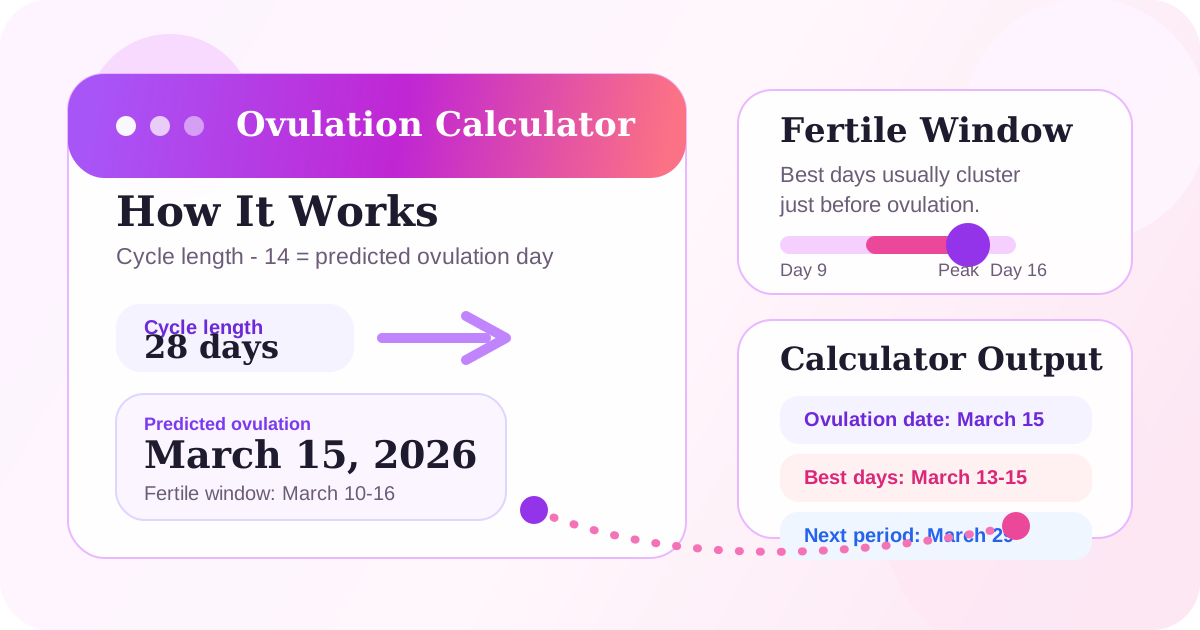
The core formula behind an ovulation date calculator is simple: ovulation day is estimated as cycle length minus 14. After that, the fertile window calculator maps the 5 days before the predicted ovulation date through ovulation day itself, and many tools also visually include the day after as a buffer for planning.
The Ovulation Calculation Formula
Step 1: Find your ovulation day
Ovulation Day = Cycle Length - 14
Step 2: Calculate your fertile window
Fertile Window Start = Ovulation Day - 5
Fertile Window End = Ovulation Day + 1
Step 3: Predict your next period
Next Period = Last Period Start + Cycle Length
Example: 28-day cycle, last period March 1
Ovulation: March 1 + (28 - 14) = March 15
Fertile window: March 10 to March 16
Next period: March 1 + 28 = March 29
That formula is why the same ovulation calculator gives different answers for different cycle lengths. If your cycle length changes, the predicted ovulation day changes with it. The calculator is not memorizing a universal Day 14 rule. It is shifting the ovulation date according to cycle length.
The Luteal Phase Assumption
The entire formula rests on one biological assumption: the luteal phase, meaning the time from ovulation to the next period, is often around 14 days and is usually less variable than the follicular phase. That is what makes backward counting possible. If the luteal phase were wildly unstable, an ovulation calculator would not work as well as a practical planning tool.
Research on cycle phases suggests that the luteal phase often falls in a narrower range than the follicular phase, but it is not fixed at exactly 14 days for everyone. Fehring and colleagues described meaningful individual variation, and studies of the LH surge relative to ovulation show that day-to-day fertility timing is never perfectly identical from cycle to cycle.
How Luteal Phase Length Affects the Calculation
| Luteal phase | Ovulation day in a 28-day cycle | Impact on prediction |
|---|---|---|
| 10 days | Day 18 | Calculator predicts too early |
| 12 days | Day 16 | Calculator is slightly early |
| 14 days | Day 14 | Calculator matches the common assumption |
| 16 days | Day 12 | Calculator predicts too late |
Most people still fall close enough to the common range that the calculator remains useful as a first-pass planning tool.
How Cycle Length Changes the Ovulation Date
One of the biggest misunderstandings about ovulation timing is the belief that everyone ovulates on Day 14. That is only true for a perfect 28-day cycle using the standard luteal-phase assumption. A 21-day cycle can ovulate around Day 7. A 35-day cycle may ovulate around Day 21. Cycle length and ovulation date move together.
Ovulation Day By Cycle Length
| Cycle Length | Ovulation Day | Fertile Window |
|---|---|---|
| 21 days | Day 7 | Day 2 - Day 8 |
| 24 days | Day 10 | Day 5 - Day 11 |
| 26 days | Day 12 | Day 7 - Day 13 |
| 28 days | Day 14 | Day 9 - Day 15Most common |
| 30 days | Day 16 | Day 11 - Day 17 |
| 32 days | Day 18 | Day 13 - Day 19 |
| 35 days | Day 21 | Day 16 - Day 22 |
Formula: Ovulation Day = Cycle Length - 14. Fertile Window = Ovulation Day - 5 through Ovulation Day + 1. This assumes an average 14-day luteal phase.
This is especially important for short cycles. If your period lasts 4 or 5 days and you have a 21-day cycle, the fertile window may begin almost immediately after bleeding stops. A calculator helps make that timing visible in a way that a vague "when do I ovulate" answer never can.
How to Use an Ovulation Calculator (Step by Step)
Using an ovulation calculator takes less than a minute, but a few details matter if you want better output. The most common mistakes happen at input stage, not calculation stage. If you enter the wrong start date or the wrong cycle length, the math can only amplify the error.
Step 1 - Enter Your Last Period Start Date
Enter the first day of your most recent period, not the last day of bleeding and not the heaviest day. In fertility tracking, the first day of menstrual bleeding is Day 1 of the cycle. That one date anchors the entire ovulation calculator.
Tip
"Last period start date" means the first day of bleeding. If you are not sure, check your calendar or use a period tracker so the date is saved automatically next cycle.
Step 2 - Enter Your Average Cycle Length
Cycle length means the number of days from the first day of one period to the first day of the next. If you are new to tracking, 28 days is a reasonable starting estimate, but it is still only a starting point. The more cycles you track, the better the calculator input becomes.
How To Find Your Average Cycle Length
Period 1 started: Jan 3
Period 2 started: Feb 1 - Cycle 1 = 29 days
Period 3 started: Mar 2 - Cycle 2 = 29 days
Period 4 started: Mar 29 - Cycle 3 = 27 days
Average = (29 + 29 + 27) / 3 = 28.3, so 28 days is the practical input.
Use the average of the last 3 to 6 cycles rather than a single unusual month. One odd cycle caused by stress, travel, or illness can skew the output more than most people expect.
Step 3 - Read Your Results
Once you enter those two values, the ovulation calculator usually gives you 4 main outputs: predicted ovulation date, fertile window, best days to conceive, and next period prediction. Treat the ovulation date as the center of a likely window, not as a guarantee that ovulation will occur on that exact day.
Step 4 - Understand the Fertile Window
The fertile window is not just ovulation day. It is the small cluster of days around ovulation when sperm survival and egg timing overlap. That is why the calculator highlights a fertile window rather than a single isolated fertility date.
Your Fertile Window Explained
Day 9 to 11: lower but real pregnancy probability
Day 12 to 13: good chance of conception
Day 13 to 14: peak fertility in a 28-day example
Day 15 to 16: fertility falls quickly after ovulation
Try Our Free Ovulation Calculator
Put the formula into practice now. Enter your last period date and cycle length below. Your ovulation date, fertile window, best days to conceive, and next period estimate update instantly. No sign-up is required.
Ovulation Calculator
Enter your last period start date and average cycle length to calculate your predicted ovulation date and fertile window. Results update automatically.
Your results
Ovulation date
June 30, 2026
Fertile window
Jun 25, 2026 - Jul 1, 2026
Best days
Jun 28 - Jun 30, 2026
Next period
July 14, 2026
This is a planning estimate based on your cycle history, not hormone detection.
See Full Calendar & 6-Month PredictionsWhat the Calculator Outputs - Explained
Most people use the ovulation calculator for the headline answer: when do I ovulate? But the surrounding outputs matter just as much, because conception planning depends on a sequence of days, not just one label on a calendar.
Ovulation Date
The ovulation date is the predicted day the egg is likely to be released. It is calculated as last period start date plus cycle length minus 14. The egg is usually viable for only about 12 to 24 hours, which is why this date gets so much attention. Even so, the day before ovulation is often just as important, or even more important, because sperm should ideally already be waiting.
Fertile Window (6 Days)
The fertile window is the 6-day stretch in which pregnancy is biologically plausible. It usually includes the 5 days before ovulation plus ovulation day. Some calculators visually extend one extra day for simplicity, but the biological logic centers on sperm survival before ovulation rather than long fertility after it.
Conception Probability
Conception probability within the fertile window
Best Days to Conceive (Peak Fertility)
Peak fertility usually means the 2 days before predicted ovulation and ovulation day itself. This is where the highest conception probabilities cluster in fertile couples. A good practical plan is intercourse every 1 to 2 days through that peak window rather than trying to time a single perfect moment.
Next Period Prediction
The next period estimate is simply last period start plus cycle length. It uses the same cycle logic as the period calculator, so you can use that tool if you want a longer forecast across several months rather than just the current cycle.
How Accurate Is an Ovulation Calculator?
This is the most important question for anyone using an ovulation calculator for conception planning. The honest answer is that accuracy depends heavily on how regular your cycles are and on what you mean by "accurate." Exact-day prediction is much harder than identifying a useful planning window.
Accuracy for Regular Cycles
If your cycle length is highly consistent, the ovulation calculator becomes much more useful as a planning tool. The less your cycle varies, the less the predicted fertile window drifts. But even regular cycles are not perfectly identical because the follicular phase can still shift from month to month.
Planning Accuracy for Regular Cycles
| Cycle variation | Practical planning accuracy |
|---|---|
| Plus or minus 1 to 2 days | Often useful within a narrow 2-day planning range |
| Plus or minus 3 to 4 days | Usually still useful for deciding when to start OPKs |
| Plus or minus 5 to 7 days | Fertile-window estimate stays useful, exact-day confidence falls |
These are planning heuristics, not direct validation-study percentages. Exact-day prediction is weaker than fertile-window planning.
The key point is that a regular cycle gives the calculator a narrower target. You should still update the result every cycle with the new last period date and use a period tracker if you want the average cycle length to stay realistic.
Accuracy for Irregular Cycles
Accuracy drops quickly when cycles are irregular because the follicular phase is the part most likely to stretch or compress. If one cycle is 24 days and the next is 35, the predicted ovulation day may shift by nearly two weeks. A calculator cannot fix that uncertainty with better math because the underlying biology is what changed.
In irregular cycles, the ovulation calculator is still worth using, but mostly as a way to identify an earlier and later boundary for when ovulation might happen. For more detail on the causes of an irregular cycle, read our guide on irregular period.
Why Ovulation Does Not Always Happen on Day 14
Day 14 is a teaching shorthand, not a universal law. Even in a stable 28-day cycle, the actual day of ovulation may move slightly because stress, sleep disruption, travel, illness, caloric restriction, or hormonal variation can delay or occasionally advance follicular development. This is one reason the calculator gives you a fertile window rather than a single fertility timestamp.
ASRM has also noted that calendar-based apps have meaningful limits when compared with direct LH-based methods, and one cited comparison study found low exact-day prediction against urinary LH testing. That does not make the calculator useless. It makes it honest to say that an ovulation calculator works best as a planning tool and not as proof that ovulation definitely happened on a specific date.
Common Myth vs. Reality
Myth
I have a 28-day cycle, so I always ovulate on Day 14.
Reality
Day 14 is the average for a textbook 28-day cycle, but real ovulation can drift by several days even in otherwise regular cycles.
Myth
If I ovulate late, my period timing will not change.
Reality
Late ovulation usually means a later period because the next bleed typically follows about a luteal phase later.
Myth
One negative OPK means I am not ovulating this cycle.
Reality
You may simply have tested too early, too late, or missed a short LH surge. Timing and repeat testing matter.
Ovulation Calculator vs. Other Ovulation Tracking Methods
If you want to understand how an ovulation calculator works in the real world, compare it with the other methods people actually use. The calculator offers speed and convenience. Other methods offer real-time clues or retrospective confirmation.
Ovulation Tracking Methods Compared
| Method | Predicts | Confirms | Cost | Accuracy |
|---|---|---|---|---|
| Calendar Calculator | Yes | No | Free | Moderate |
| Test OPK strips | Yes | Yes | Low | High |
| Thermometer BBT tracking | No | Yes | Low | High after ovulation |
| Mucus Cervical mucus | Yes | Yes | Free | Moderate to high |
| Clinic Ultrasound | Yes | Yes | High | Very high |
| Recommended combination: calculator for planning, OPK strips for confirmation, and mucus or BBT for extra context. | ||||
vs. Ovulation Predictor Kits (OPKs)
OPK strips detect the LH surge that usually appears 24 to 36 hours before ovulation. That makes them much more actionable for the current cycle than an ovulation calculator on its own. The calculator tells you when to expect the fertile window. The OPK helps confirm that the body is approaching ovulation now.
Calculator vs. OPK Strips
Calculator
Free, instant, and good for planning based on cycle history.
Less reliable for irregular cycles and does not detect hormones.
OPK strips
Low cost and much closer to real-time fertility physiology.
Require daily testing and can be more confusing in some PCOS patterns.
The best use pattern is simple: use the calculator to know when to start testing, then use OPKs to narrow the exact timing. If you want to learn the real body signs around that surge, read our signs of ovulation guide.
vs. Basal Body Temperature (BBT) Tracking
BBT tracking answers a different question. The ovulation calculator predicts future timing. BBT usually confirms that ovulation has already happened because progesterone raises resting body temperature after the egg is released. That means BBT is excellent for pattern learning across cycles but weaker for same-cycle action if you are trying to conceive right now.
Calculator vs. BBT Tracking
Calculator: predicts future ovulation with no daily effort.
BBT: confirms past ovulation but requires a basal thermometer and daily morning temperatures.
Together: BBT helps you see whether the calculator's assumptions are matching your real pattern over time.
vs. Cervical Mucus Monitoring
Cervical mucus monitoring gives you a real-time physiologic clue that the fertile window is approaching. Clear, slippery, stretchy mucus often appears in the days before ovulation. That makes it one of the best free companions to an ovulation calculator because it can tell you when a theoretical fertile window is becoming a real one in the current cycle.
The learning curve is the challenge. Some people need time to tell the difference between fertile mucus, non-fertile discharge, semen residue, and changes caused by medications or vaginal infection. The calculator provides the time frame; mucus gives the cycle-specific clue.
The Symptothermal Method: Combining All Three
The symptothermal approach combines calendar timing, cervical mucus, and BBT. In practice, many people also add OPK strips, which creates a stronger version of the same logic: timing plus symptoms plus objective confirmation. This approach demands more learning and consistency, but it gives a much richer fertility map than any one tool alone.
Recommended Combination Approach
Week 1 and 2: use the calculator to identify your likely fertile window.
Three to four days before predicted ovulation: begin daily OPK testing.
Throughout the cycle: monitor cervical mucus and take BBT each morning before getting up.
Result: the calculator gives the framework, OPKs narrow the timing, and mucus plus BBT add confirmation.
How to Get the Most Accurate Results
You cannot make a calendar tool behave like a lab test, but you can make the inputs much better. Most people get more value from the ovulation calculator simply by cleaning up how they track and how they interpret the result.
6 Tips for Better Ovulation Calculator Accuracy
1. Track at least 3 cycles first
The more cycle data you have, the more realistic your average cycle length becomes.
2. Use average cycle length, not your last cycle
A single unusual month can distort the result more than a 3-cycle or 6-cycle average.
3. Always enter the first day of your period
That first day is Day 1 of the cycle and anchors everything else in the calculation.
4. Start OPK testing early
Begin 3 to 4 days before predicted ovulation so you do not miss an earlier-than-expected LH surge.
5. Log stress, travel, and illness
Those are common reasons the calculator looks "wrong" when the body has actually shifted timing.
6. Recalculate every cycle
Do not reuse a prediction from months ago. Refresh the ovulation calculator after every new period.
Ovulation Calculator for Irregular Cycles
An ovulation calculator can still help with irregular cycles, but the job changes. Instead of expecting one precise ovulation day, you use the calculator to define the earliest and latest plausible fertile window based on recent cycle history. That shifts it from a precision tool to a range-planning tool.
Using the Calculator With Irregular Cycles
Step 1: Find your shortest and longest recent cycles, such as 24 days and 35 days.
Step 2: Estimate ovulation from both edges. That means ovulation might happen from about Day 10 to Day 21.
Step 3: Start OPK testing before the earliest likely ovulation date and continue until positive or past the latest likely date.
Step 4: Watch for fertile cervical mucus to decide when to test more often.
This is why LH strips matter more with an irregular cycle. Calendar timing alone becomes too broad. If your periods are unpredictable, you should also understand why, not just when. Our guide to irregular period causes can help you figure out which factors might be shifting ovulation in the first place.
Common Mistakes When Using an Ovulation Calculator
Most ovulation calculator failures come from user assumptions rather than broken formulas. Once you see the common mistakes, the tool becomes much easier to use correctly.
7 Common Ovulation Calculator Mistakes
Mistake #1
Entering the last day of the period instead of the first day.
Fix: Always use Day 1 of bleeding.
Mistake #2
Using the last cycle length instead of an average.
Fix: Average your last 3 to 6 cycles.
Mistake #3
Assuming ovulation is always Day 14.
Fix: Use cycle length minus 14 instead.
Mistake #4
Trying only on ovulation day.
Fix: Start 2 to 3 days before predicted ovulation.
Mistake #5
Not recalculating each cycle.
Fix: Update after every new period.
Mistake #6
Treating the result as exact.
Fix: Treat it as a range and confirm with OPKs if needed.
Mistake #7
Giving up after one negative OPK.
Fix: Test again, often twice daily near the predicted window.
Ovulation Calculator and Trying to Conceive
The best use of an ovulation calculator for trying to conceive is to turn vague timing into an action plan. It helps you know when to start paying closer attention, when to test, and when intercourse is most likely to line up with the fertile window. It does not diagnose infertility and it does not tell you whether an egg was actually released. It helps you plan better around when conception is most likely.
Conception Action Plan
Day -5 to -3
PrepareBegin OPK testing once daily and watch for slippery, egg-white mucus.
Day -3 to -1
ImportantIncrease OPK testing to twice daily and have intercourse every 1 to 2 days.
Day -2
HighOne of the best days to conceive if sperm are already present before ovulation.
Day -1
HighestOften the strongest conception day because sperm are in place before egg release.
Day 0
HighOvulation day itself is still a high-priority day for conception.
Day +1
LowThe egg is usually no longer viable, so the fertile window is effectively closing.
When To See A Fertility Specialist
Under 35
After 12 months of trying without success
35 to 39
After 6 months of trying without success
40 and over
After 3 months, or ideally before trying
See someone sooner if you have:
- Irregular or absent periods
- Known PCOS, endometriosis, or thyroid disorder
- History of pelvic infection, chemotherapy, or reproductive surgery
- Prior miscarriage pattern or known male-factor fertility concerns
Medical Disclaimer
This article is for educational and planning purposes only. An ovulation calculator is not a medical device and cannot diagnose fertility problems. If you have been trying to conceive without success, consult a qualified reproductive endocrinologist or OB-GYN.
Frequently Asked Questions
These are the most common questions people ask when they want to know how an ovulation calculator works, how accurate it is, and how to use it intelligently rather than mechanically.
For more background on fertility timing, you can also review the ASRM optimizing fertility committee opinion, the Wilcox et al. NEJM study, and general ACOG guidelines.