You are in the two-week wait. You have just noticed some spotting. And now you are trying to figure out if this is the sign you have been hoping for, or your period arriving early.
The honest answer: it is genuinely difficult to tell from symptoms alone. But specific characteristics make implantation bleeding more or less likely, and there is a right time to take a pregnancy test for a reliable answer.
This guide does two things: it shows you the specific differences to look for, then it gives you a calm checker so you can decide what to do next without spiraling through another dozen tabs.
What Is Implantation Bleeding? The Biology First
Implantation bleeding can occur when a fertilized egg, now a blastocyst, burrows into the uterine lining. This usually happens about 6-12 days after ovulation.
As the blastocyst attaches, it may disrupt small blood vessels in the endometrium. That can cause light spotting, but estimates vary: about 15-25% of pregnant women report implantation bleeding. Most pregnant women do not experience it.
That last point matters. Implantation bleeding is a possible pregnancy sign, not a reliable pregnancy sign. Not seeing spotting does not mean you are not pregnant, and seeing spotting does not prove that you are. It is one clue in a bigger pattern, and the pattern still needs a pregnancy test to become an answer.
Ovulation
Day 0
Fertilization
Day 1-2
Tube travel
Day 3-4
Blastocyst in uterus
Day 5-6
Implantation window
Day 6-12
Possible spotting
After implantation
Implantation Bleeding vs Period
The 5-Characteristic Comparison
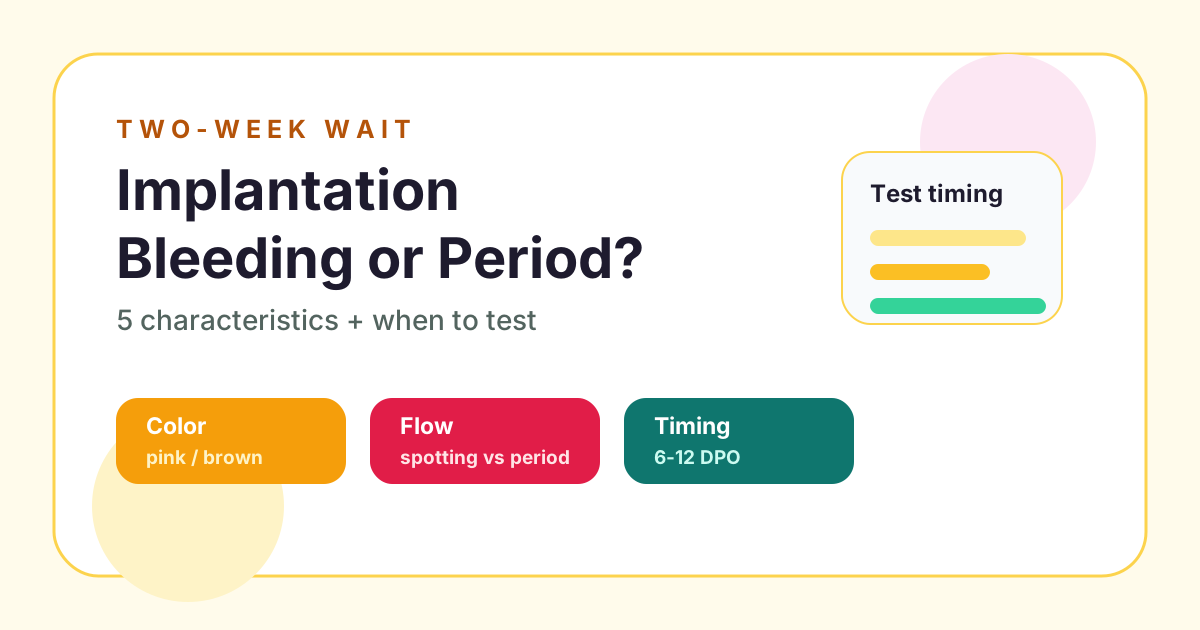
The best clues are not one symptom in isolation. Look at color, volume, duration, timing, and symptoms together.
Timing and flow carry the most weight. Color can help, but it is not enough on its own because many periods start with pink or brown spotting before becoming brighter and heavier.
The most implantation-like pattern is light pink or brown spotting that stays light, appears in the 6-12 DPO window, and does not turn into your usual flow. The most period-like pattern is bleeding that gets brighter, heavier, and more crampy over the first 24-48 hours.
| Characteristic | Implantation bleeding | Period | Reliability |
|---|---|---|---|
| Color | Pink, light pink, or brown; rarely very light red | Often starts pink/brown, then becomes bright red | ★★★☆☆ Color overlaps, so it is useful but not diagnostic. |
| Volume | Spotting only; may appear only when wiping; no clots | Light to moderate or heavy flow; may fill pads or tampons | ★★★★☆ Volume is one of the strongest clues. |
| Duration | A few hours to 1-3 days | Usually 3-7 days or your personal normal | ★★★★☆ Longer and heavier bleeding leans period. |
| Timing | Usually 6-12 DPO, often 1-5 days before expected period | On or near expected period date | ★★★★★ Timing relative to ovulation is the best clue. |
| Cramping | Mild or none | Often intensifies as flow increases | ★★☆☆☆ Cramping overlaps with PMS and early pregnancy. |
| Fills pad? | No | Often yes, especially days 2-3 | ★★★★★ Implantation bleeding does not become heavy flow. |
What Is This Bleeding?
Use the 5-characteristic checker
Answer 5 questions to get probability guidance and a practical testing window. This tool runs only in your browser.
This tool provides general guidance only. It cannot diagnose pregnancy or any medical condition. Only a pregnancy test can confirm pregnancy.
How to Read the Checker Result
A result that leans toward implantation bleeding still does not mean you are pregnant. It means the pattern is compatible with implantation bleeding: light, short, early, and not developing into period flow.
A result that leans toward period also does not mean anything is wrong. Most two-week-wait spotting turns out to be normal pre-period spotting or the beginning of a period. The important part is knowing when testing is useful and when symptoms are too overlapping to interpret.
When to Take a Pregnancy Test — The Timing Guide
The most common mistake is testing too early. hCG rises after implantation, then takes a few more days to reach detectable levels.
A negative test before your period is due can be emotionally loud, but biologically incomplete. It may only mean there was not enough hCG in urine yet, especially if implantation happened later in the 6-12 DPO window.
If you test early, treat the result as temporary unless your period arrives. If the test is negative and bleeding stays spotting-only, repeat in 48 hours. If bleeding becomes a normal period, track it as cycle day one.
Ovulation
Day 0
↓ 6-12 days
Implantation
6-12 DPO
↓ 2-3 days
hCG detectable
8-15 DPO
↓ 2-3 more days
Most tests reliable
10-17 DPO
DPO reference
⚠️ Before 10 DPO
Too early — likely false negative
🟡 10-12 DPO
Sensitive tests may work
✅ 12-14 DPO
Most tests reliable
✅ 14+ DPO
Test now if period has not arrived
FRER: about 6.3 mIU/mL hCG.
Standard brands: often 20-25 mIU/mL hCG.
Other Causes of Mid-Cycle or Pre-Period Spotting
Not all spotting in the two-week wait is implantation bleeding. Several common causes can look similar, especially when you are watching every sign closely.
The goal is not to memorize every possible cause. It is to notice the pattern: where you are in the cycle, whether the bleeding stays spotting-only, whether it follows sex or an exam, and whether it becomes your usual period flow.
If spotting is new for you, write down the date, color, flow, pain level, and whether it happened after sex. One isolated episode is often not enough to identify a cause. A repeated pattern over several cycles is much more useful for your doctor and much less confusing for you.
Ovulation spottingTiming: Around ovulation
Very brief spotting from follicle rupture. It happens much earlier than implantation bleeding.
Progesterone dropTiming: 1-3 days before period
Light pink or brown spotting before full flow begins. This is common pre-period spotting.
Cervical sensitivityTiming: Any time
Sex, an internal check, or cervical irritation can cause brief pink or brown spotting.
Hormonal fluctuationTiming: Variable
Breakthrough bleeding is more common after starting or stopping hormonal contraception and in perimenopause.
Cervical polyp or ectropionTiming: Often after sex
Usually benign cervical changes can bleed easily, but persistent spotting should be checked.
When spotting needs prompt medical evaluation
- Heavy bleeding at any point in pregnancy.
- Spotting with severe one-sided pelvic pain.
- Spotting after a confirmed positive pregnancy test.
- Persistent unexplained spotting for 3 or more cycles.
The Emotional Reality of the Two-Week Wait
The two-week wait is genuinely hard. Every twinge, every spot of blood, every unusual sensation can start to feel meaningful.
If you cannot tell what is happening, that does not mean you are missing something obvious. Implantation signs, early pregnancy symptoms, and PMS are allowed to look almost identical.
The kindest plan is usually the most practical one: decide your testing day, stop re-checking the same symptoms every hour if you can, and give yourself a next step for both outcomes. A positive test has a next step. A negative test has a next step too.
1. Symptom-spotting is unreliable
Early pregnancy symptoms and PMS symptoms are both driven by progesterone. The symptoms are genuinely identical.
2. Implantation bleeding is not a strong predictor
Most pregnant women do not have it, and spotting can happen for many non-pregnancy reasons.
3. The test is the answer
No amount of symptom analysis gives a reliable answer before hCG is detectable.
4. A negative before 12 DPO is not final
It may only mean hCG was not detectable yet. If your period does not arrive, test again in 48 hours.
5. One negative cycle is not a verdict
Even with good timing, per-cycle conception is often around 25-30%. Most people need multiple cycles.
Track your cycle to make the next TWW clearer.